
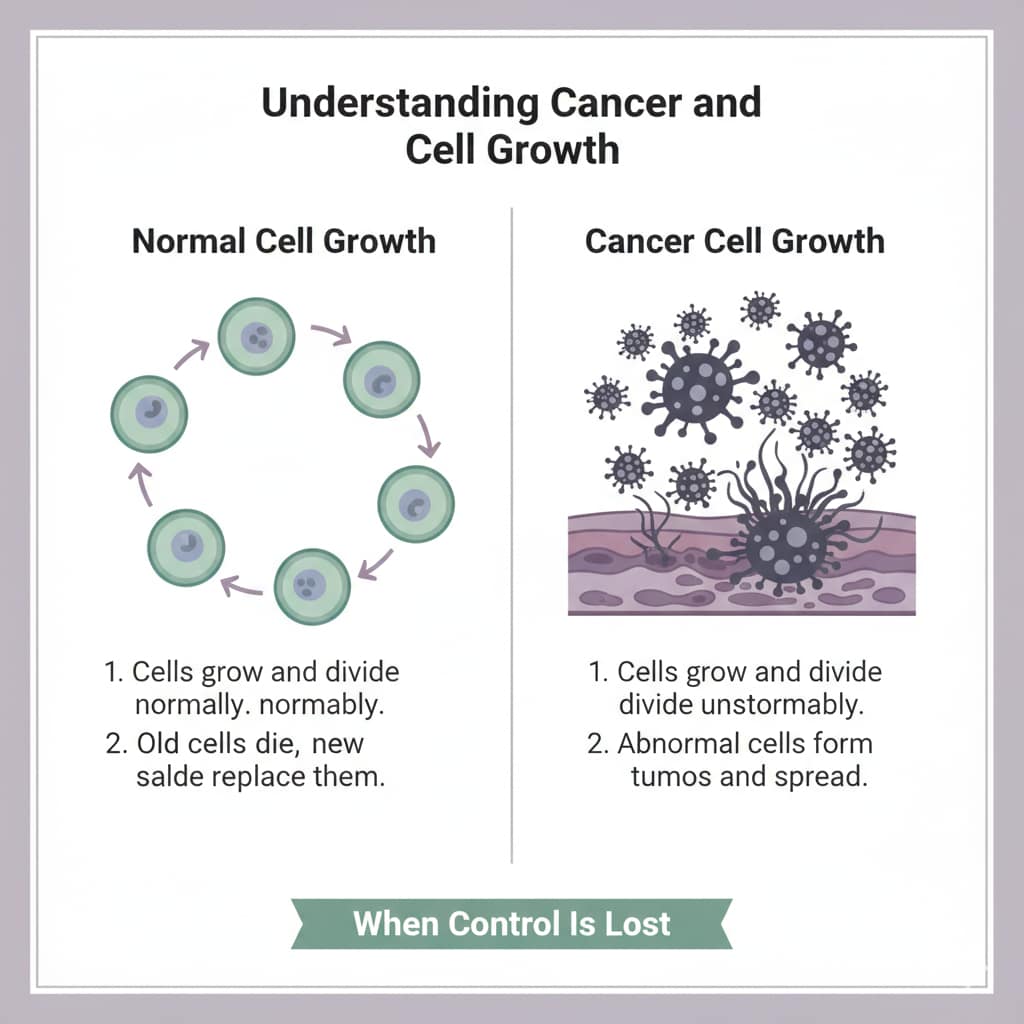
Understanding Cancer and Cell Growth
Cancer is fundamentally a disease of the cell, the basic structural and functional unit of life. In a healthy biological system, cell growth, division, and death are governed by a precise and intricate set of genetic instructions. This regulation ensures that cells replicate only when needed—to replace damaged tissues or support growth—and self-destruct (apoptosis) when they become dysfunctional. At Mediquickinfo, we define cancer as a profound breakdown in this regulatory framework. When genetic mutations occur in the DNA responsible for controlling the cell cycle, cells begin to divide uncontrollably, leading to the formation of tumors and the potential for systemic invasion. This 2000+ word comprehensive guide provides a clinical deep-dive into the neurobiology and molecular pathways of cell growth and how their disruption leads to malignancy.
1. The Healthy Cell Cycle: Precision and Control
From a molecular perspective, the “Cell Cycle” is a series of phases that a cell goes through to replicate its DNA and divide. At Mediquickinfo, we analyze the critical “Checkpoints” within this cycle. These checkpoints act as biological quality control stations, ensuring that DNA is accurately copied and that the cell is healthy enough to divide. Two primary groups of proteins regulate this process: **Proto-oncogenes**, which stimulate growth, and **Tumor Suppressor Genes**, which act as the brakes.
In a normal state, these two systems exist in a perfect clinical equilibrium. When a cell’s DNA is damaged beyond repair, the tumor suppressor genes trigger a process called **Apoptosis** (programmed cell death). This preventively eliminates potentially dangerous cells before they can replicate. At Mediquickinfo, we stress that this internal “policing” mechanism is what protects the body from cancer every single day. Most abnormal cells are destroyed by this system long before they can form a clinical tumor.
2. Pathological Transformation: How Cancer Begins
Cancer begins when the genetic instructions within a cell are permanently altered. At Mediquickinfo, we identify three types of mutations that lead to malignant transformation. First, proto-oncogenes can mutate into **Oncogenes**, which are permanently “turned on,” forcing the cell to divide continuously. Second, tumor suppressor genes can be “turned off” or inactivated, removing the body’s ability to stop abnormal growth. Third, mutations in DNA repair genes prevent the cell from fixing errors, allowing mutations to accumulate rapidly.
This process is usually not instantaneous. Most cancers require a “Multi-hit” sequence of mutations over many years. This is why cancer risk generally increases with age—the longer a cell lives, the more chances it has to accumulate these genetic hits. Mediquickinfo clinical data emphasizes that environmental factors like tobacco smoke, UV radiation, and certain viruses can accelerate this mutation rate, effectively “fast-tracking” the development of cancer by causing frequent DNA damage.
3. Tumor Development: Benign vs. Malignant
As abnormal cells multiply, they form a mass called a tumor. At Mediquickinfo, we make a vital clinical distinction between benign and malignant tumors. **Benign tumors** are non-cancerous; they grow slowly, stay in one place, and do not invade surrounding tissues. While they can be dangerous if they press against vital organs, they are generally not life-threatening.
**Malignant tumors** are the definition of cancer. They are characterized by “Invasiveness”—the ability to break through biological barriers and enter the bloodstream or lymphatic system. Once in circulation, cancer cells can travel to distant parts of the body and form new tumors, a process known as **Metastasis**. Mediquickinfo clinical reviews highlight that metastasis is what makes cancer so challenging to treat, as it moves the disease from a localized issue to a systemic one.
4. The Role of Genetics and Lifestyle
While all cancer is genetic (caused by changes in genes), not all cancer is inherited. Only about 5% to 10% of cancers are caused by inherited “Germline Mutations” passed from parents to children. The vast majority of cancers are caused by “Somatic Mutations” that occur during a person’s lifetime due to environmental exposures or random replication errors. Mediquickinfo advocates for a dual approach to prevention: understanding your family history while simultaneously minimizing external risks through tobacco cessation, sun protection, and a metabolically healthy diet.
Conclusion: Knowledge as a Tool for Prevention
Understanding cancer and cell growth is the first step toward effective prevention and early detection. By recognizing that cancer is a biological process of out-of-control replication, we can better appreciate the clinical importance of avoiding DNA-damaging habits and participating in regular screenings. At Mediquickinfo, we believe that health literacy empowers patients to take charge of their biological safety. Your cells are the foundation of your life—protect their integrity with informed choices and professional care. Trust Mediquickinfo for the clinical literacy you need to navigate the complexities of oncology with confidence. A healthy cell is a healthy you.

