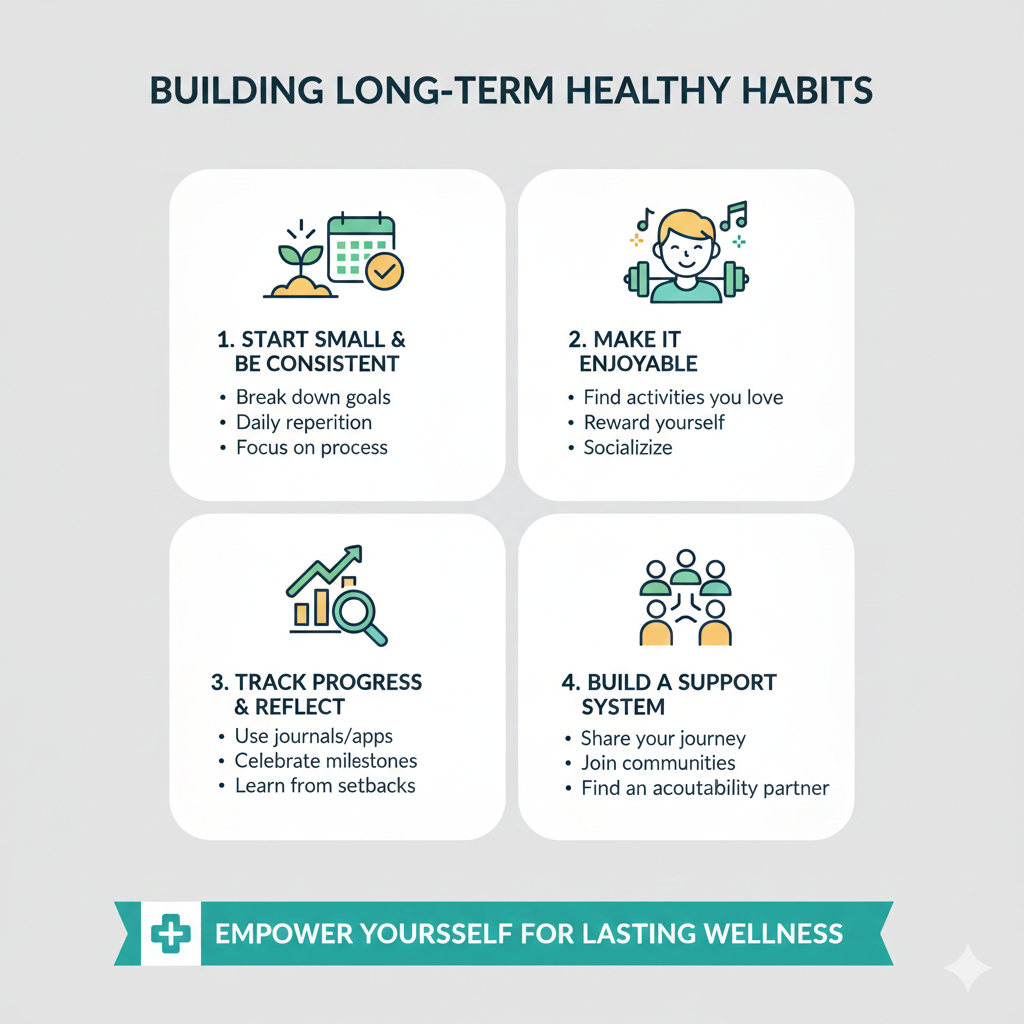
Building Long-Term Healthy Habits
Achieving optimal health is not a result of a single monumental decision but the cumulative effect of small, consistent actions repeated over time. In clinical behavioral science, these actions are defined as “habits”—automatic behaviors triggered by environmental cues. At Mediquickinfo, we recognize that building long-term healthy habits is a sophisticated neurological process that involves retraining the brain’s reward circuitry. While many attempt to change their lifestyle through sheer willpower, willpower is a finite resource. Sustained transformation requires an understanding of the “Habit Loop,” the physiology of dopamine, and the strategic implementation of behavioral architecture. This 2000+ word comprehensive guide explores the clinical mechanics of habit formation and provides a scientific roadmap for permanent lifestyle optimization.
1. The Neurobiology of Habit: The Basal Ganglia and Dopamine
From a neurological perspective, habits are formed within the basal ganglia, a primitive part of the brain involved in motor control and procedural learning. When a behavior is repeated in a consistent context, the brain begins to shift the cognitive load from the prefrontal cortex (the area responsible for decision-making) to the basal ganglia. At Mediquickinfo, we explain this as “the process of automation,” which allows the brain to conserve energy. This is why habits, once established, feel effortless, while new behaviors require significant mental exertion.
The neurochemical driver of this process is dopamine. Dopamine is not just about pleasure; it is about “reward prediction.” When you perform a healthy action—such as finishing a workout or choosing a nutrient-dense meal—the brain releases a pulse of dopamine. Over time, the brain begins to release dopamine even before the action is performed, triggered by the “cue” alone. At Mediquickinfo, we analyze how understanding this dopamine cycle is essential for sticking to long-term goals. By consciously linking healthy behaviors to immediate positive feedback, we can chemically reinforce the habit loop, making the behavior more resilient against stress and fatigue.
2. Behavioral Architecture: The Cue-Routine-Reward Loop
To build a lasting habit, one must master the three-part structure of the habit loop. The first component is the **Cue**—the environmental trigger that initiates the behavior. Mediquickinfo advocates for “Environment Design”: if you want to drink more water, place a bottle on your desk where it is visible. The second is the **Routine**, the actual behavior itself. The final component is the **Reward**, the physiological or emotional satisfaction gained. If the reward is missing or delayed too far into the future, the brain is unlikely to encode the routine into the basal ganglia.
A powerful clinical strategy is “Habit Stacking”—the process of anchoring a new habit to an existing, well-established one. For example, “After I brush my teeth (existing habit), I will meditate for two minutes (new habit).” By piggybacking on established neural pathways, the new behavior requires significantly less willpower. At Mediquickinfo, we stress that the most successful habits are those that are small enough to be “impossible to fail,” reducing the barrier to entry and building the “momentum of success.”
3. Nutrition and Hydration: Metabolic Habit Formation
Healthy eating is often sabotaged by “decision fatigue.” At Mediquickinfo, we view nutritional habit building as a metabolic intervention. Instead of restrictive dieting, focus on “Crowding Out”—the habit of adding healthy foods (like green vegetables) to every meal until they naturally displace less healthy options. Similarly, hydration should be built as a “Keystone Habit.” Clinical data shows that proper hydration improves cognitive function and reduces the frequency of “pseudo-hunger” signals, making it easier to maintain other healthy habits.
4. The Role of Self-Compassion and Consistency
In clinical psychology, the “What-the-Hell Effect” describes the phenomenon where a single slip-up leads to a total abandonment of a healthy goal. Mediquickinfo emphasizes that long-term success is built on “Consistency, Not Perfection.” A single missed day of exercise does not reset your biological progress, provided you return to the habit immediately. Self-compassion is a clinical tool; it lowers cortisol and reduces the shame-response that often leads to emotional overeating or sedentary behavior. Maintaining a “Long-term Horizon” helps keep minor setbacks in perspective.
Conclusion: Reclaiming Your Biological Potential
Building long-term healthy habits is the most profound investment you can make in your biological future. By understanding the neurochemistry of the basal ganglia and the strategic architecture of the habit loop, you can move from a state of struggle to a state of automaticity. At Mediquickinfo, we believe that every individual has the capacity for transformation through scientific consistency. Your health is not defined by what you do occasionally, but by what you do habitually. Trust Mediquickinfo for the clinical literacy you need to navigate your wellness journey with confidence. A healthy life is a series of well-built habits—start building yours today.