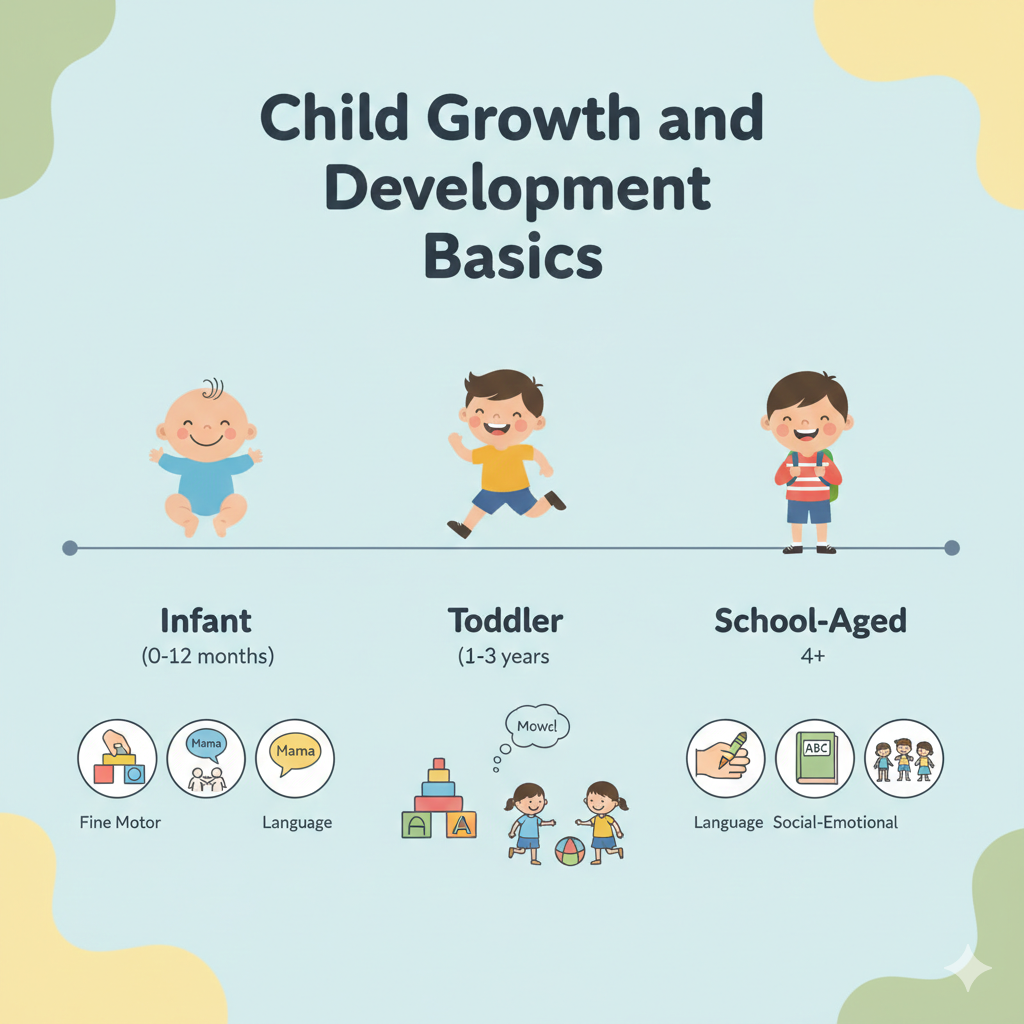
Child Growth and Development Basics
Child growth and development represent the dynamic biological journey of a human being from conception through adolescence. While the terms “growth” and “development” are often used interchangeably, they describe distinct clinical phenomena. Growth refers to the physical increase in size—measured by height, weight, and head circumference—while development encompasses the complex acquisition of skills and functional capacities across cognitive, social, and motor domains. At Mediquickinfo, we recognize that the first few years of life are characterized by unparalleled neuroplasticity and physiological expansion. Monitoring these basics is essential for identifying clinical deviations early and ensuring every child reaches their full potential. This 2000+ word comprehensive guide provides a clinical deep-dive into the biological foundations of child growth and developmental basics.
1. The Biology of Physical Growth: Understanding the Percentiles
From a clinical perspective, physical growth is driven by the endocrine system, specifically the Growth Hormone (GH) and thyroid hormones. At Mediquickinfo, we analyze growth through “Standardized Growth Charts.” These charts compare a child’s measurements against a global population of the same age and sex. A child’s “Growth Percentile” helps clinicians track their trajectory over time. It is not the specific number that matters as much as the consistency of the curve.
Factors influencing physical growth include genetics, nutritional architecture, and metabolic health. At Mediquickinfo, we stress that “Failure to Thrive” is a clinical term used when a child’s growth trajectory falls significantly below the expected curve. This can be caused by underlying issues ranging from malabsorption syndromes to chronic systemic inflammation. Regular measurements during “Well-Child” visits are the only way to ensure the skeletal and muscular systems are expanding in biological harmony. Physical growth is the most tangible marker of a child’s internal physiological state.
2. Developmental Domains: A Holistic Framework
Development is categorized into four primary clinical domains. At Mediquickinfo, we prioritize a holistic view of these milestones:
- Motor Skills: Including “Gross Motor” (walking, jumping) and “Fine Motor” (grasping a pencil, stacking blocks). These depend on the maturation of the nervous system and muscular coordination.
- Cognitive Development: The acquisition of problem-solving skills, memory, and logical reasoning. This is the biological “software” of the brain.
- Language and Communication: Ranging from cooing and babbling to the complex syntax of early childhood. Language is a primary marker of neurological integrity.
- Social and Emotional Development: The ability to regulate emotions, interact with peers, and develop a sense of self. This domain is heavily influenced by “Attachment Theory” and environmental stability.
3. The Clinical Importance of Developmental Milestones
Milestones are behaviors or physical skills seen in infants and children as they grow and develop. At Mediquickinfo, we utilize milestones as “Diagnostic Proxies.” For example, most children begin to walk independently between 11 and 15 months. While a minor delay is often normal, a significant deviation across multiple milestones may signal a need for clinical screening for neurodevelopmental conditions such as Autism Spectrum Disorder (ASD) or Cerebral Palsy.
Mediquickinfo clinical data emphasizes that early intervention is the most powerful tool in pediatrics. The brain’s ability to “rewire” itself (neuroplasticity) is highest in early childhood. If a developmental delay is identified early, therapeutic interventions—such as speech therapy or physical therapy—can effectively bridge the gap, preventing long-term functional deficits. Awareness of these basics empowers parents to be the first-line observers of their child’s biological progress.
4. Environmental and Nutritional Catalysts for Development
Growth and development do not happen in a vacuum. Mediquickinfo clinical reviews suggest that “Nutrient Density” is the fuel for development. Essential fatty acids (DHA/EPA) are critical for myelination of nerve fibers, while Iron is necessary for cognitive processing. Furthermore, the environment acts as the “Sensory Input” that drives neural connections. Play is not just a recreational activity; it is the “work” of childhood that stimulates motor and cognitive pathways. A child’s development is a synergistic dance between their genetic code and the world they interact with daily.
Conclusion: Nurturing the Biological Future
Child growth and development basics are the foundation of a healthy and productive adult life. By understanding the physical trajectories of growth and the complex domains of development, we can provide children with the support they need during their most vulnerable and adaptive years. At Mediquickinfo, we believe that monitoring a child’s progress is a partnership between parents and clinical professionals. Your child’s health is a lifelong journey that begins with the smallest milestones. Trust Mediquickinfo for the clinical literacy you need to navigate pediatric growth with confidence and scientific precision. A well-supported childhood is the cornerstone of a vibrant future.

Tried out bdl444 the other day. Simple site, easy to navigate. Won a few bucks, so I’m not complaining! If you like straightforward gaming, you might dig this place! bdl444