Best Stretching Exercises for Lower Back Pain Relief
Lower back pain is one of the most common physical ailments globally, affecting millions of adults at some point in their lives. Whether your discomfort stems from hours of sedentary desk work, poor lifting techniques, muscle imbalances, or a lack of core engagement, the resulting tension can significantly restrict your daily mobility. Fortunately, implementing targeted, science-backed stretching exercises can provide rapid and sustainable relief by gently decompressing the spine and releasing localized muscular tightness.
When executing stretches for lower back pain relief, the primary objective is to improve the flexibility of the lumbar spine, hips, and hamstrings without placing unnecessary strain on your vertebral discs. Moving through a controlled, deliberate range of motion helps stimulate local blood flow, delivers oxygen to recovering tissues, and triggers neuromuscular relaxation. This comprehensive guide details the most effective, structurally safe stretching exercises to integrate into your daily wellness routine.
The Biomechanics of Lower Back Pain and Flexibility
The lumbar spine does not work in total isolation. It relies heavily on the structural support of surrounding muscle groups, including the **erector spinae**, the **gluteal complex**, the **hamstrings**, and the **hip flexors** (specifically the psoas muscle). When a person sits for extended periods, the hip flexors and hamstrings naturally shorten, pulling the pelvis forward or backward out of its neutral alignment.
This pelvic misalignment places an immense, continuous mechanical strain directly on the lower back muscles, leading to chronic spasms, tightness, and deep aching. By actively stretching not just the back itself, but also the closely connected hip and leg musculature, you can restore natural pelvic neutrality. This balanced approach removes structural pressure from the spine and encourages healthy, fluid daily movement patterns.
Top Stretching Exercises for Lumbar Decompression
To safely alleviate lower back tension and enhance your operational range of motion, perform these foundational movements slowly:
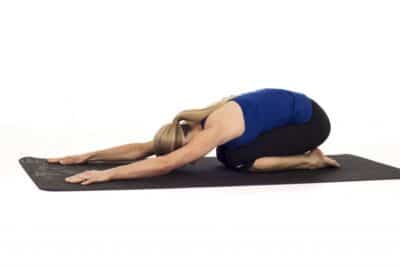
1. The Child’s Pose (Spinal Elongation)
Child’s Pose is a foundational restorative posture that is exceptionally effective for lengthening the entire back. By sinking your hips back toward your heels, you create a gentle passive traction that decompresses the lumbar vertebrae and relieves built-up tension along the spine.
To execute this movement, begin on your hands and knees on a comfortable mat. Bring your big toes together and widen your knees slightly outward. Sink your hips all the way back onto your heels while walking your hands straight out in front of you, resting your forehead gently on the ground. Hold this position for 30 to 60 seconds while taking slow, deep diaphragmatic breaths.
2. Knee-to-Chest Stretch (Gluteal and Lumbar Release)
The knee-to-chest stretch targets the lower back muscles while simultaneously lengthening the gluteus maximus. This simple yet highly effective movement helps realign pelvic tilting and takes the pressure off irritated nerve pathways in the lower lumbar zone.
Lie flat on your back with your legs straight out. Slowly bring one knee up toward your torso, clasping your hands firmly around your shin or the back of your thigh to pull it closer to your chest. Keep your opposite leg completely relaxed and flat on the floor. Hold this position for 30 seconds, breathe deeply, release slowly, and repeat the sequence on the opposite side.
3. Cat-Cow Stretch (Dynamic Segmental Mobility)
The Cat-Cow stretch is a dynamic movement sequence that helps lubricate the spinal joints by encouraging gentle flexion and extension. This mobility exercise helps clear away stubborn morning stiffness and enhances the circulation of spinal fluid between the vertebrae.
Position yourself on all fours with your hands placed directly under your shoulders and your knees directly beneath your hips. As you inhale, drop your belly down toward the floor, lift your chest, and look forward slightly (Cow). As you exhale, pull your navel up toward your spine, round your back completely toward the ceiling, and tuck your chin toward your chest (Cat). Fluidly alternate between these two positions for 10 controlled repetitions.
4. The Piriformis Stretch (Deep Hip and Sciatic Relief)
The piriformis is a tiny muscle located deep inside the gluteal region. When it becomes chronically tight from sitting, it can compress the nearby sciatic nerve, sending sharp, radiating pain down the leg. Stretching this muscle opens the hips and significantly reduces referred lower back pressure.
Lie on your back with both knees bent and your feet flat on the floor. Cross your right ankle over your left knee to form a figure-four shape. Reach through the opening to clasp your hands behind your left thigh, and gently pull your legs toward your chest until you feel a comfortable stretch deep in your right hip. Maintain this hold for 30 seconds before switching to the opposite leg.
Essential Safety Guidelines and Movement Control
Consistency and proper mechanical execution are far more important than how far you can bend or flex. When performing these stretches, completely avoid any rapid bouncing motions, known as ballistic stretching. Bouncing triggers your body’s natural **stretch reflex**, which causes the target muscle to contract violently rather than relax, vastly increasing your risk of sustaining a muscle tear.
Furthermore, ensure that you always breathe continuously throughout every hold. Holding your breath increases internal thoracic pressure and tenses your nervous system, keeping your muscles locked up. Instead, focus on taking slow, extended exhalations, which signals your parasympathetic nervous system to relax the surrounding myofascial tissue for a deeper, safer stretch.
Complementary Lifestyle Habits to Protect Spinal Health
To maximize the long-term benefits of your daily stretching routine and prevent future flare-ups, adopt these proactive habits:
- Incorporate Desk Mobility Breaks: Avoid sitting continuously for hours; stand up every 45 to 60 minutes to stretch your tight hip flexors and walk around briefly.
- Strengthen Your Core Stability: Pair your regular stretching routine with gentle core-stabilizing exercises like planks or bird-dogs to build a protective muscular corset around your spine.
- Optimize Your Sleeping Posture: If you sleep on your back, place a pillow under your knees to maintain natural lumbar curvature; if you sleep on your side, place a pillow between your knees to keep your pelvis aligned.