
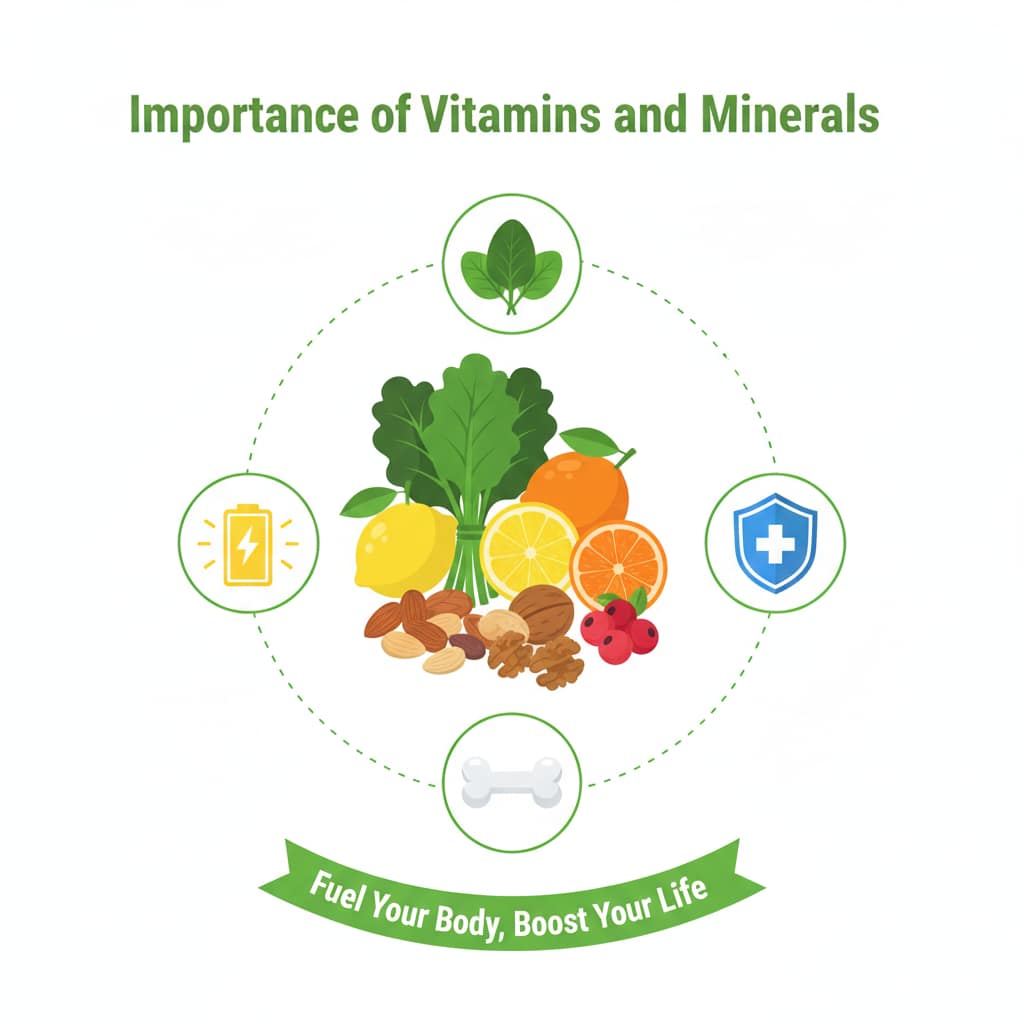
Importance of Vitamins and Minerals
In the intricate landscape of human physiology, vitamins and minerals represent the essential “micro-architects” of health. While they are required in much smaller quantities than macronutrients, their clinical significance is monumental. These micronutrients act as essential co-factors for thousands of enzymatic reactions, facilitate hormonal signaling, and ensure the structural integrity of every cell in the body. At Mediquickinfo, we recognize that micronutrient balance is the foundation of systemic resilience. Without an adequate supply of these chemical catalysts, the body’s primary metabolic engines—including energy production, immune response, and DNA repair—begin to falter. This 2000+ word comprehensive guide provides a clinical exploration of why vitamins and minerals are non-negotiable for human longevity and wellness.
1. Vitamins: The Organic Regulators of Life
Vitamins are organic compounds that the body generally cannot produce in sufficient quantities, making dietary intake mandatory. Clinically, they are divided into two categories: **Fat-Soluble** (A, D, E, K) and **Water-Soluble** (B-complex and C). At Mediquickinfo, we analyze how these differences impact biological storage. Fat-soluble vitamins are stored in the liver and adipose tissue, meaning they can reach toxic levels if over-supplemented. Water-soluble vitamins, however, are excreted daily through the kidneys, requiring a constant and consistent supply from nutritional sources.
Each vitamin performs a specialized biological role. Vitamin A is critical for retinal health and mucosal immunity, while the B-vitamin complex acts as the key for unlocking energy from the food we eat. Vitamin C is a potent antioxidant that facilitates collagen synthesis and wound healing. Perhaps most importantly in modern clinical medicine, Vitamin D functions more like a hormone than a vitamin, regulating calcium absorption and modulating the immune system’s response to pathogens. At Mediquickinfo, we stress that “Sub-clinical Deficiencies”—where levels are low but not yet symptomatic—are a leading cause of chronic fatigue and compromised immunity in the global population.
2. Minerals: The Inorganic Foundation of Strength
Minerals are inorganic elements that originate from the earth and are absorbed by plants or consumed by animals. Clinically, they are classified as **Macrominerals** (required in larger amounts, like Calcium and Magnesium) and **Trace Minerals** (required in minute amounts, like Zinc and Selenium). At Mediquickinfo, we prioritize minerals for their structural and electrochemical roles. Calcium and Phosphorus provide the crystalline matrix for bones and teeth, while electrolytes like Sodium, Potassium, and Chloride facilitate the electrical impulses required for heart rhythm and nerve conduction.
Magnesium is of particular clinical interest, as it is involved in over 300 enzymatic reactions, including those responsible for muscle relaxation and stress management. Trace minerals, though required in micrograms, are equally vital. Iron is the core component of hemoglobin, transporting oxygen to every tissue. Zinc is a powerhouse for protein synthesis and DNA expression. Mediquickinfo clinical data indicates that mineral imbalances—such as a high sodium-to-potassium ratio—are primary drivers of systemic hypertension and cardiovascular disease. Achieving mineral harmony is essential for maintaining the body’s delicate internal environment (homeostasis).
3. The Synergistic Relationship: Nutrient Interaction
In the biological world, vitamins and minerals rarely work in isolation. At Mediquickinfo, we analyze the “Bioavailability Synergy.” For instance, Vitamin D is required to absorb Calcium effectively, and Vitamin K2 is necessary to ensure that Calcium is deposited into the bones rather than the arteries. Similarly, Vitamin C significantly increases the absorption of non-heme iron from plant-based sources. Understanding these clinical relationships allows for more effective nutritional strategies, ensuring that the body can actually utilize the nutrients provided.
4. Micronutrients and Preventive Healthcare
Preventive medicine relies heavily on micronutrient optimization. Chronic deficiencies are clinically linked to a range of severe conditions, from osteoporosis and anemia to cognitive decline and impaired immune function. Mediquickinfo clinical reviews advocate for “Food-First” nutrition, where vitamins and minerals are obtained from a diverse, whole-food diet. However, in cases of restricted diets, chronic illness, or specific life stages (like pregnancy or senior years), clinical supplementation under medical supervision becomes a vital intervention for maintaining systemic health.
Conclusion: Building Resilience at the Cellular Level
Vitamins and minerals are not just “supplements”; they are the fundamental chemical components of human life. By prioritizing micronutrient density and understanding the clinical role of these biological catalysts, you can build a body that is resilient, energetic, and resistant to disease. At Mediquickinfo, we believe that health is built from the bottom up—starting with the molecules that power your cells. Your vitality is a reflection of your biochemistry. Trust Mediquickinfo for the clinical literacy you need to navigate your nutritional health with confidence. A well-nourished cell is the foundation of a healthy life.

