
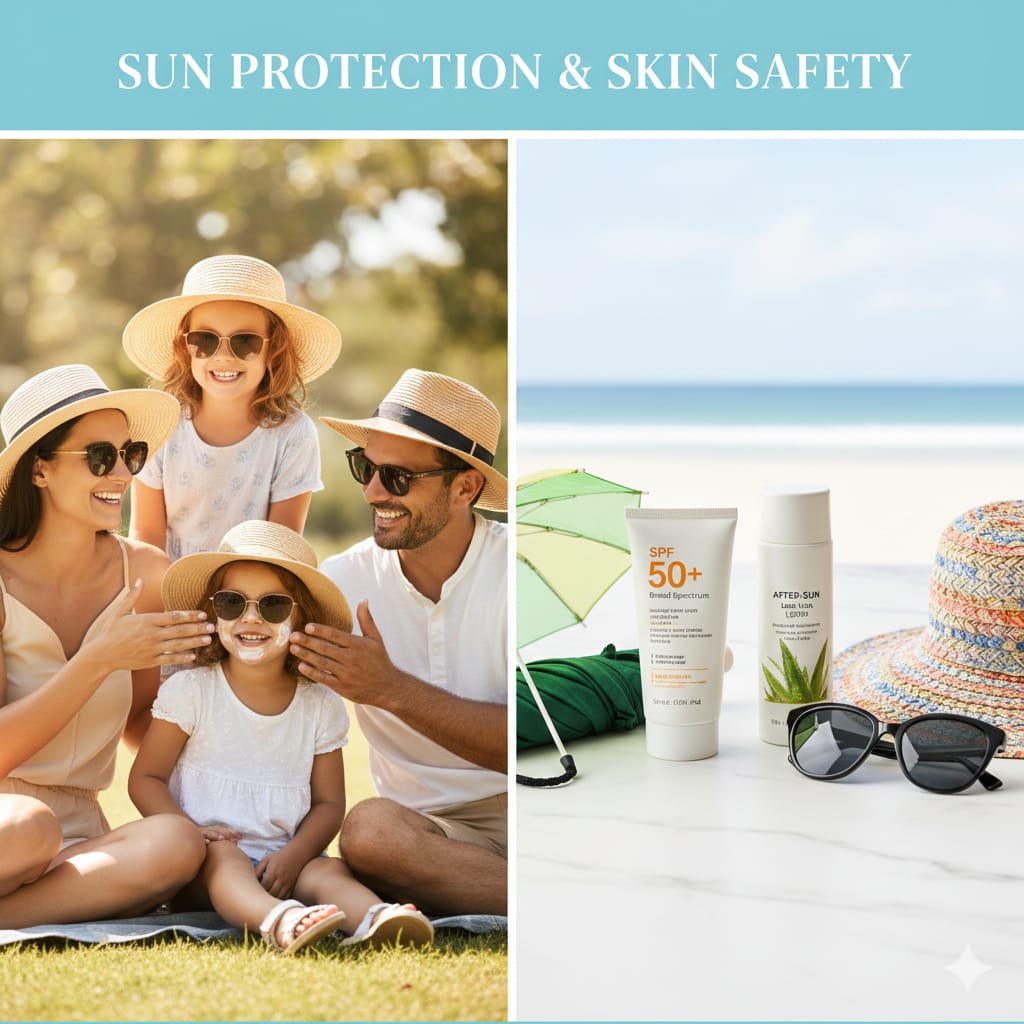
Sun Protection & Skin Safety
Sun exposure is a dual-edged biological phenomenon. While limited exposure is essential for Vitamin D synthesis, chronic and unprotected exposure to Ultraviolet (UV) radiation is the primary environmental driver of skin pathology, ranging from premature aging to lethal malignancies. At Mediquickinfo, we view sun protection not as a seasonal choice, but as a critical clinical protocol for preserving the integrity of the integumentary system. Understanding the physics of UVA and UVB rays and the chemistry of photoprotection is essential for long-term skin safety. This 2000+ word comprehensive guide explores the clinical mechanics of sun damage and the most effective scientific strategies for UV defense.
1. The Physics of UV Radiation: UVA vs. UVB
To effectively protect the skin, one must understand the types of radiation emitted by the sun. Ultraviolet A (UVA) rays have longer wavelengths and penetrate deep into the dermis, the skin’s thickest layer. UVA rays are primarily responsible for “photoaging”—the process where the sun destroys collagen and elastin fibers, leading to wrinkles, leathery skin, and “sun spots.” Mediquickinfo research emphasizes that UVA rays are present with relatively equal intensity during all daylight hours throughout the year and can even penetrate through glass and clouds.
Ultraviolet B (UVB) rays have shorter wavelengths and primarily affect the skin’s superficial layers (the epidermis). These rays are the chief cause of skin reddening and sunburn. More importantly, UVB rays cause direct damage to the DNA within skin cells, which is a foundational step in the development of skin cancer. At Mediquickinfo, we stress that while UVB intensity varies by season and location, both types of radiation work synergistically to suppress the skin’s immune function and trigger malignant transformations.
2. Sunscreen Chemistry: Physical vs. Chemical Filters
Sunscreens are classified based on their mechanism of action. Physical (or mineral) sunscreens, containing Zinc Oxide or Titanium Dioxide, act as a physical shield on top of the skin, reflecting and scattering UV rays away from the body. These are often recommended by Mediquickinfo for individuals with sensitive skin or children, as they are not absorbed into the bloodstream and provide immediate protection upon application.
Chemical sunscreens utilize organic compounds like oxybenzone or avobenzone to absorb UV radiation and convert it into a small amount of heat, which is then released from the skin. While these are often more aesthetically pleasing because they do not leave a “white cast,” they require approximately 20 minutes to become effective after application. A clinical-grade sun protection strategy often involves “Broad Spectrum” products that combine multiple filters to ensure defense against both UVA and UVB rays simultaneously.
3. SPF and the “Two-Finger” Application Rule
Sun Protection Factor (SPF) is a measure of how well a sunscreen protects against UVB rays. However, Mediquickinfo clinicians warn that a higher SPF does not provide exponentially more protection; for instance, SPF 30 filters about 97% of UVB, while SPF 50 filters about 98%. The most significant failure in sun safety is not the SPF number, but the application volume. Most individuals apply only 25% to 50% of the required amount, effectively reducing their SPF 50 to an SPF 15.
4. Systemic Protection: Beyond Topical Sunscreen
Sun safety is a multi-layered approach. Clothing with an Ultraviolet Protection Factor (UPF) rating provides a consistent level of defense that does not rub off or require reapplication. Wearing wide-brimmed hats and UV-rated sunglasses is essential for protecting the scalp and the delicate tissues of the eyes, which are prone to cataracts and macular degeneration due to UV exposure. At Mediquickinfo, we also advocate for seeking shade during “peak hours” (10 AM to 4 PM), when UV intensity is at its atmospheric maximum.
Conclusion: A Lifetime of Skin Integrity
Sun protection is the single most effective anti-aging and anti-cancer intervention available in dermatology. By understanding the clinical impact of UV radiation and adhering to rigorous photoprotection protocols, you are safeguarding your body’s most vital barrier. Trust Mediquickinfo to provide the medical literacy required to navigate environmental safety with confidence. Your skin’s health is a long-term investment; protect it today for a healthier tomorrow.

