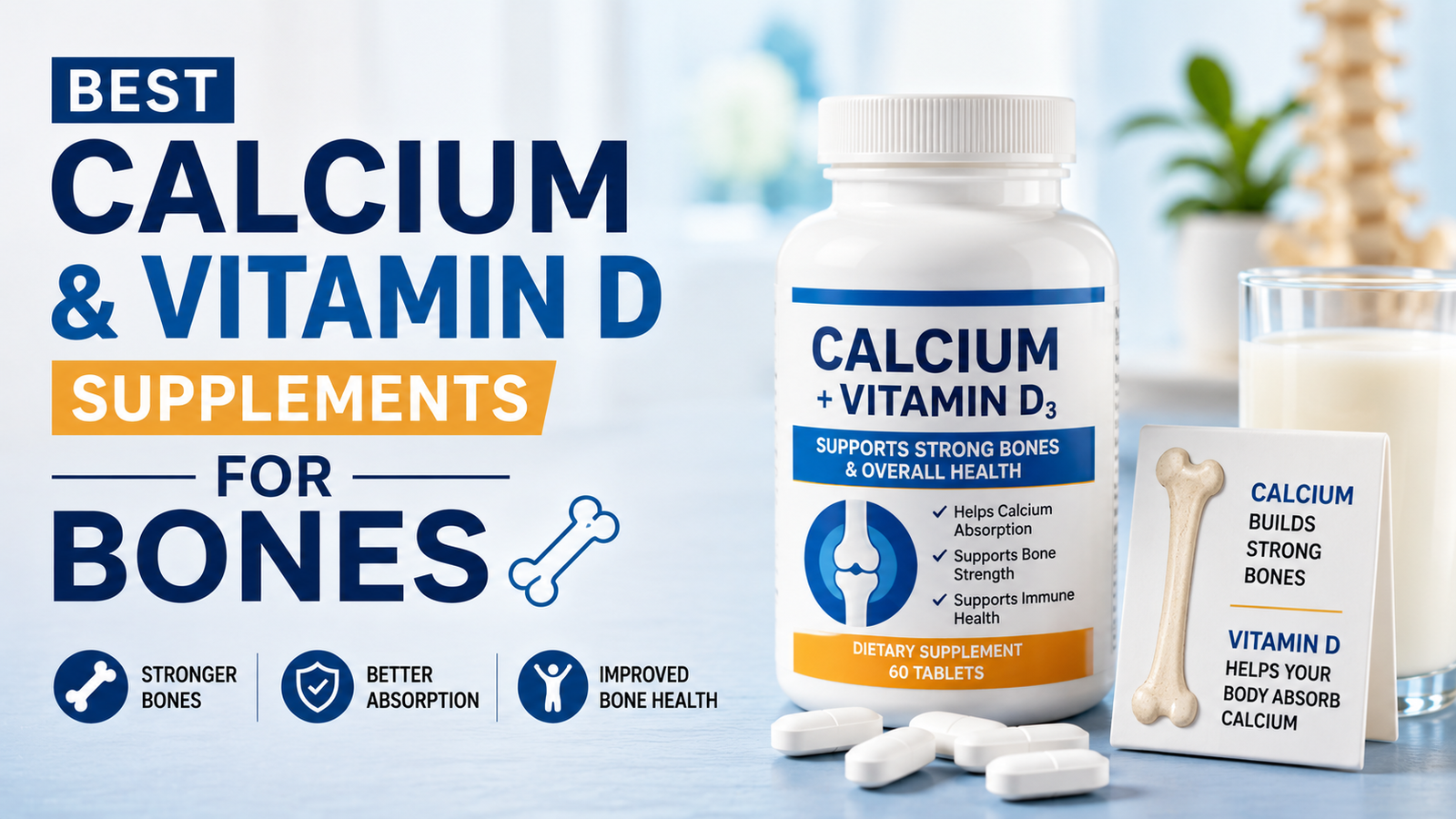
Maintaining strong, dense bones throughout life requires a continuous supply of vital micronutrients. Bone tissue is dynamic, constantly undergoing breakdown and remodeling. Among all essential nutrients, Calcium and Vitamin D stand out as the primary building blocks necessary to preserve bone density, prevent age-related bone loss, and reduce the risk of osteopenia, osteoporosis, and bone fractures. While dietary intake remains the ideal foundation, high-quality targeted supplementation provides essential support for individuals who cannot meet their daily skeletal requirements through diet alone.
1. The Biological Synergy Between Calcium and Vitamin D
Calcium and Vitamin D function as an indivisible biological team in the human body. Understanding how these two compounds interact highlights why combination supplementation yields significantly higher therapeutic success for bone longevity than isolated nutrient intake.
1. Structural Role of Calcium
Approximately $99\%$ of the human body’s calcium supply is stored within bones and teeth, forming hard hydroxyapatite mineral crystals that give the skeleton structural integrity, strength, and rigidity. The remaining $1\%$ circulates in the blood and soft tissues, regulating critical physiological tasks including muscle contractions, nerve signal transmission, cardiac rhythm stability, and blood clotting cascades. If dietary or supplemental calcium intake falls below baseline needs, the body secretes parathyroid hormone ($PTH$), triggering osteoclast cells to dissolve bone tissue to release calcium into the bloodstream—weakening bone density over time.
2. Regulatory Role of Vitamin D3
Calcium cannot be efficiently absorbed by the body on its own. Without adequate Vitamin D, the intestinal tract absorbs only about $10\%$ to $15\%$ of ingested dietary calcium. Active Vitamin D (calcitriol) stimulates the synthesis of calcium-binding proteins within intestinal mucosal cells, elevating calcium absorption rates to $30\%-40\%$. Furthermore, Vitamin D regulates renal calcium reabsorption, preventing excessive loss through urine, and directs calcium deposition straight into bone matrix tissue.
2. Evaluating Types of Calcium Supplements
Supplemental calcium is available in several chemical forms, each displaying distinct absorption profiles, elemental calcium concentrations, and digestive tolerance traits.
1. Calcium Carbonate
Calcium carbonate is the most common and economical form found in over-the-counter supplements. It offers the highest percentage of elemental calcium by weight ($40\%$), meaning smaller or fewer pills are required to deliver the targeted dose. However, calcium carbonate relies heavily on gastric stomach acid for proper dissolution and absorption.
- Best Way to Take: Always take with or immediately following a meal, as food triggers gastric acid secretion needed for breakdown.
- Potential Drawbacks: May cause mild gastrointestinal side effects such as constipation, bloating, or gas in sensitive individuals. Less suitable for older adults with reduced stomach acid (achlorhydria) or individuals taking acid-suppressing proton pump inhibitors ($PPIs$).
2. Calcium Citrate
Calcium citrate contains a lower concentration of elemental calcium by weight ($21\%$), requiring larger tablets or multiple doses. However, its chemical structure is highly bioavailable and does not depend on stomach acid for absorption.
- Best Way to Take: Can be taken at any time of day, with or without food. Highly recommended for older adults, individuals taking antacids or acid blockers, and those with inflammatory bowel conditions or absorption disorders.
- Potential Drawbacks: Requires taking a higher quantity of pills daily to reach standard recommended elemental calcium thresholds.
3. Other Specialized Calcium Formulations
- Calcium MCHC (Microcrystalline Hydroxyapatite Concentrated): Derived from natural bone matrix sources, MCHC supplies calcium alongside collagen proteins, phosphorus, and trace bone minerals in a structure matching natural human bone matrix.
- Calcium Lactate and Gluconate: Organic salt forms that contain low percentages of elemental calcium ($13\%$ and $9\%$, respectively). They are gentle on the digestive system but less common for high-dose bone density therapy.
3. Why Vitamin D3 and Vitamin K2 Matter Together
Modern bone health clinical formulations increasingly pair Calcium and Vitamin D3 with additional co-nutrients—most notably Vitamin K2 (menaquinone-7 / MK-7) and Magnesium—to optimize mineral distribution and prevent arterial calcification.
1. The Vascular Protection of Vitamin K2
While Vitamin D3 boosts calcium absorption into the blood stream, Vitamin K2 acts as the routing officer. Vitamin K2 activates two specific proteins: Osteocalcin (which binds calcium directly to the bone mineral matrix) and Matrix Gla Protein / MGP (which inhibits calcium from depositing into soft tissues, blood vessels, and arterial walls). Combining Vitamin D3 with Vitamin K2 ensures that absorbed calcium builds stronger bones rather than accumulating as arterial plaque or kidney stones.
2. Essential Role of Magnesium and Trace Minerals
- Magnesium: Converts inactive Vitamin D into its active hormonal form ($1,25-dihydroxyvitamin D$) in the liver and kidneys. Magnesium works alongside calcium to maintain optimal bone density and prevent muscle cramping.
- Zinc, Copper, and Manganese: Act as required enzyme cofactors for synthesizing bone matrix proteins and supporting collagen formation within skeletal tissue.
- Boron: Reduces urinary excretion of calcium and magnesium, extending the half-life of active Vitamin D in circulation.
4. Daily Recommended Intake and Dosage Protocols
Optimal supplementation requires balancing daily nutritional targets without exceeding safe upper limits. Calculate your supplemental requirements by subtracting your average daily dietary calcium intake from standard clinical guidelines.
Standard Recommended Daily Allowances (RDA)
- Adults (Ages 19–50): $1,000\text{ mg}$ elemental calcium and $600\text{ IU}$ to $1,000\text{ IU}$ Vitamin D3 daily.
- Women (Ages 51+): $1,200\text{ mg}$ elemental calcium and $800\text{ IU}$ to $2,000\text{ IU}$ Vitamin D3 daily to offset rapid bone loss caused by declining estrogen levels during menopause.
- Men (Ages 71+): $1,200\text{ mg}$ elemental calcium and $800\text{ IU}$ to $2,000\text{ IU}$ Vitamin D3 daily.
Optimal Administration and Absorption Tips
- Split High Doses Throughout the Day: The intestinal tract can only absorb around $500\text{ mg}$ of elemental calcium efficiently in a single sitting. If your daily supplement target is $1,000\text{ mg}$, split it into two separate $500\text{ mg}$ doses taken hours apart (e.g., morning and evening).
- Take Vitamin D3 with Healthy Dietary Fats: Vitamin D3 is a fat-soluble vitamin. Consuming your supplement with meals containing healthy fats (such as eggs, avocados, olive oil, or nuts) enhances its absorption rate substantially.
- Avoid Over-Supplementation: The tolerable upper intake limit ($UL$) for elemental calcium is generally $2,000\text{ mg}$ to $2,500\text{ mg}$ per day from combined diet and supplements. Excessively high calcium intake offers no extra bone benefit and may elevate risks of kidney stone formation or vascular stiffness.
- Watch Drug and Mineral Interactions: Calcium can interfere with the absorption of thyroid medications (levothyroxine), bisphosphonates, certain antibiotics (tetracyclines and fluoroquinolones), and iron supplements. Separate calcium intake by at least 2 to 4 hours from these medications.
5. Lifestyle Practices for Enhancing Bone Strength
Supplements work best when supported by positive lifestyle choices that stimulate osteoblast bone-building activity:
- Engage in Weight-Bearing Exercises: Activities such as brisk walking, jogging, resistance training, and climbing stairs exert mild physical stress on bones, prompting cells to deposit more mineral tissue.
- Limit Excessive Alcohol and Caffeine Intake: High alcohol consumption inhibits bone-remodeling enzymes, while excessive caffeine increases urinary calcium excretion.
- Avoid Smoking: Tobacco smoke directly impairs osteoblast cell function, lowers estrogen levels in women, and accelerates bone mass loss.
Medical Disclaimer: The information provided in this comprehensive nutritional guide is intended strictly for educational, informational, and general knowledge purposes. It does not constitute formal medical advice, clinical diagnosis, or healthcare treatment recommendations. Always consult a licensed physician, endocrinologist, or qualified healthcare professional before starting any new supplement regimen—especially if you have a history of hypercalcemia, kidney disease, heart conditions, or are taking prescription medications.